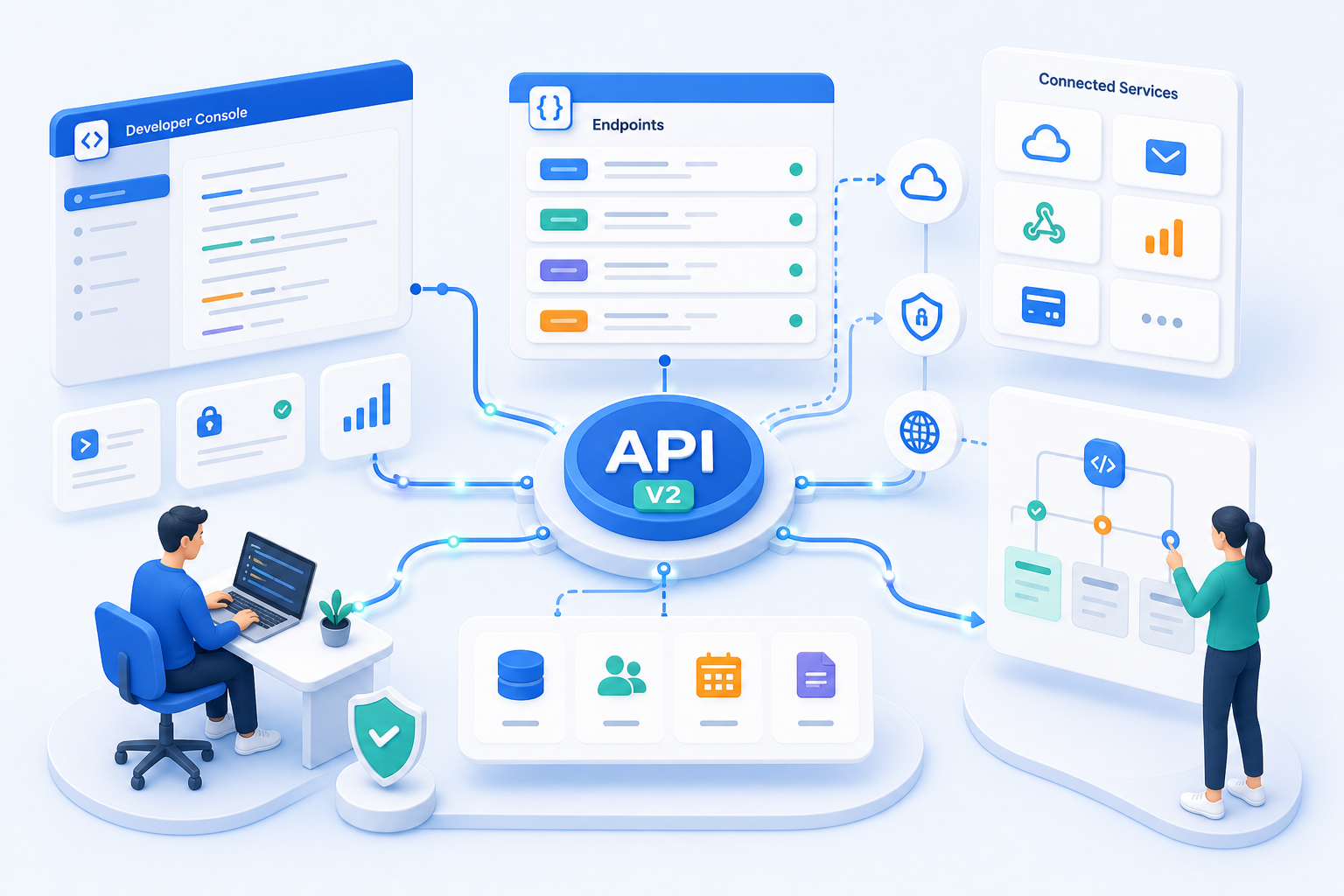
Integrating edoobox into existing system environments
When CRM, ERP, learning platforms, or internal portals need data, the API provides a documented method instead of manual exports.
Administration & Organization
Course Manager CRM Participants Task Planner ResourcesMarketing & Growth
Promotions Manager Email Automation Website Integration Global Reach (AI)Finance & Controlling
Payment Hub Billing Billing and Collections ReportingTechnology & Security
REST API V2 Webhooks design manager Integrate Tools Security Plan Privacy PolicyIndustries
Educational ProvidersAssociations & OrganizationsEvent & Activity ProvidersCorporate TrainingAcademies & InstitutionsMore
News Prices Courses Documentation for the current version of edooboxThe REST API V2 opens up edoobox for custom applications, specialized front ends, and controlled data flows. Teams keep edoobox as their operational core and expand its capabilities where standard methods fall short.

When CRM, ERP, learning platforms, or internal portals need data, the API provides a documented method instead of manual exports.
Custom logic can be built on top of edoobox data, while registration, participant management, and payment processes remain centralized.
When CRM, ERP, learning platforms, or internal portals need data, the API provides a documented method instead of manual exports.
Custom logic can be built on top of edoobox data, while registration, participant management, and payment processes remain centralized.
If embedding or the standard design are not sufficient, custom front ends can be connected to edoobox via the API.
API-based processes are easier to audit than ad hoc manual data transfers between tools.
With the REST API V2, you can seamlessly integrate edoobox with existing systems, platforms, and your own workflows. Data flows remain traceable, interfaces are clearly documented, and custom processes are more scalable.
If you need custom data flows, your own front ends, or deep system integrations, the API is usually the cleaner approach.
No. Webhooks deliver events, while the API is suitable for targeted data access and more complex processes. Using both together can be useful.
Yes. Especially in larger system environments, it provides more control than purely manual or semi-automatic handoffs.
Yes. The API can be used when standard embeddings are not sufficient and custom interfaces are required.
Create your free edoobox trial account. Afterward, we'll work with you during a personalized online introduction to set up your first course offering.