
Growth means more courses, more participants, and more revenue. But it also means more administrative work. This article explains when manual processes become more expensive than a professional online booking system—and how you can identify that tipping point using your own data.
Many course providers start out pragmatically: an Excel spreadsheet here, a calendar there, and booking requests via email. This works—as long as the course offerings remain manageable.
Things get complicated when these processes are supposed to scale up. Whether it’s an external training program or an in-house training initiative: duplicate entries, forgotten feedback, delayed invoices, and unclear participant lists quietly creep in. As long as the time spent and errors aren’t tracked, the chaos remains hidden. It rarely starts with a big bang—usually with one too many minor hiccups.
Growth doesn’t just mean more registrations. In practice, many things grow at the same time—more concurrent courses and course options, more participants with individual needs, more invoices, cancellations, and rescheduling, as well as more communication before, during, and after the course.
The administrative burden often increases disproportionately. Here’s a simple example: 10 courses with 10 participants each result in 100 data records. 20 courses with 20 participants each result in 400 data records. The number of courses has doubled—the administrative workload has quadrupled.
Time is the cost factor that is most easily overlooked when organizing courses manually. Individual tasks may seem minor, but collectively, they hinder growth.
Common time-wasters without an online booking system:
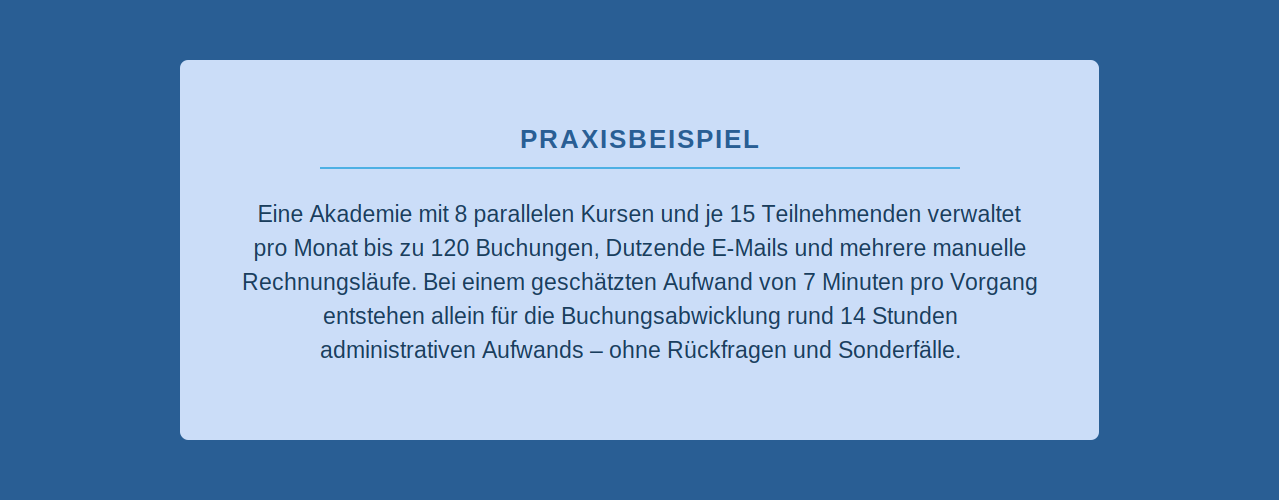
Even by conservative estimates: A single booking, including follow-up inquiries and follow-ups, can easily take 5–10 minutes of administrative time. With 100 bookings per month, that adds up to as many as 15 hours—every month. Time that is then lacking for product development, marketing, or quality assurance.
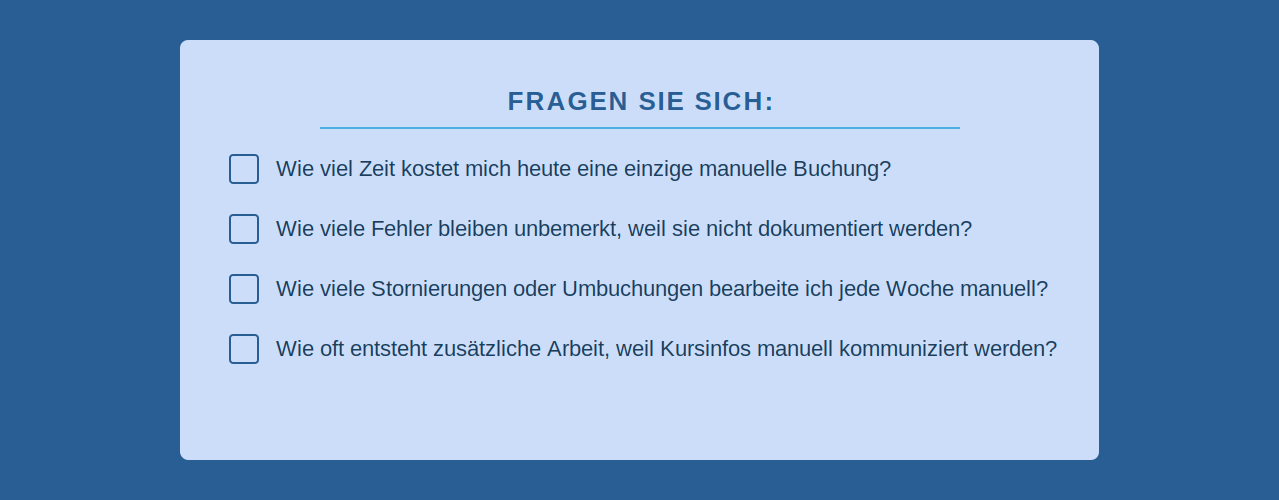
Errors do not result from incompetence—they occur when systems are not designed to scale. Studies show that manual data entry has an average error rate of 1–4% (Invensis, 2025). For 400 data records, that means 4 to 16 erroneous entries—per month.
The consequences are well known: duplicate bookings that need to be resolved at short notice, incorrect participant numbers, outdated price lists, or missing documentation for DSG/GDPR requirements. The result is a loss of trust among participants and internal frustration.
As the number of bookings increases, so does the administrative overhead: more participants mean more inquiries, more special cases, and more coordination. Without a central database, support quickly becomes a bottleneck—not because the customers are complicated, but because the processes are.
There is no one-size-fits-all threshold. As a general guideline, it’s worth taking a closer look at your processes if you manage around 50–100 bookings per month, run more than 5–10 courses simultaneously, or coordinate multiple target groups and pricing structures.
This doesn’t mean that every company has to take immediate action once it reaches this threshold. But from this point on, you should consciously calculate the time required, the cost of errors, and the coordination effort—rather than simply estimating them. A professional system then serves not as a “luxury,” but as a cost-saving measure.
A common misconception: A system doesn’t replace people—it replaces repetitive decisions and manual steps. Registration and confirmation processes run automatically, participant management is centralized and easy to navigate, payment flows are documented, and reminders are sent automatically. With edoobox, you can also manage your entire course catalog in 28 languages—without any hassle.
This shifts the focus of work: away from day-to-day administration and toward strategic management. That is the essence of scalability. You can find more information about edoobox’s features here.
Many providers put off deciding on a system—because they feel they are still too small or have other priorities. This assumption should be examined critically.
The later processes are systematized, the higher the costs of transition, data migration, and internal adjustments will be. This applies to external course providers as well as to corporate departments that are setting up their professional development infrastructure. Establishing a structure early on is usually more cost-effective than making corrections later.
Another point that is often overlooked: a lack of structure takes its toll on data quality. Anyone who manages participant data across multiple Excel spreadsheets risks inconsistencies and, as a result, problems with GDPR compliance.
Not every course management system is a good fit for every business model. What matters isn’t the longest list of features, but the right fit. Look for flexible course and pricing structures, intuitive administration that doesn’t require a steep learning curve, and transparent booking and payment processes. Equally important: reliable, personalized support and clear compliance with the DSG/GDPR—especially if you manage participant data from Switzerland or the EU.
edoobox is an online booking system developed in Switzerland that is used by everyone from small schools and academies to medium-sized companies offering in-house courses. The documentation provides a detailed overview of its features and configuration options.
A professional course registration system doesn't pay for itself "someday," but rather at a specific point: when the cost of manual labor exceeds the cost of automating the process.
Those who wait until chaos becomes apparent often end up paying twice: in time, stress, and missed growth opportunities. The cold, hard facts show that structure is more cost-effective than improvisation.
If growth means more work than progress for you, it’s worth taking a structured look at your processes. With edoobox, you get a professional online booking system designed specifically for growing course providers—flexible, user-friendly, and legally compliant.
👉 Try edoobox for 10 days with no obligation and use your actual data to see when it starts paying off for you.


